Short answer: Dropshipping (or dropship, drop ship) is a way to sell online where you don't keep stock in a warehouse. Customers order on your website, you forward the order to the supplier, and the supplier ships directly to the customer. Your profit is the gap between the selling price and the cost price, after deducting ad spend, payment processing fees, and refunds.
This article is for Vietnamese people who want to dropship to the US and run their own Facebook ads. Most of it is general knowledge, so you can follow along even without using any of our tools.
I'm Ánh Nguyễn. I've been dropshipping and running ads for years, and I also build SpyWinAds, a Facebook ad spy tool. SpyWinAds data covers ads shown in the US, not ads in Vietnam.
What Is Dropshipping?
Dropshipping is a retail model. The seller handles sales: building the website, running ads, and supporting customers. The supplier handles storing, packing, and shipping the products.
Dropship, drop ship, and dropshipping are the same concept, just spelled differently. In Vietnam, "làm dropship" usually means selling to the US, Europe, or Australia through a Shopify store. The goods come from factories in China or warehouses in the US.
Dropshipping is not "business with no capital." You don't pay upfront for inventory, but you must invest in ads. That cost is often much larger than the cost of building the website.
How Does Dropshipping Work?
An Order Goes Through 6 Steps
- Choose a product and find a supplier that will ship individual orders.
- Build a store on Shopify, Wix, or a funnel page like ClickFunnels. Then add products, set prices, and connect a payment gateway.
- Run ads, most commonly on Facebook/Instagram. Some people also run Google Shopping.
- Customer places an order and pays you through the payment gateway.
- You re-place the order with the supplier, paying the cost price plus shipping.
- Supplier ships the order and sends a tracking number. You update the customer with the tracking number, then handle complaints or refunds if any.
Many people add a CRM or email app to send abandoned cart emails, order tracking emails, and follow-ups to past customers. You don't need it at the start. It becomes worthwhile once you have steady orders.
How is dropshipping different from traditional retail and POD?
| Traditional retail | Dropship | POD (print on demand) | |
|---|---|---|---|
| Inventory | Yes, bought upfront | No | No, printed when ordered |
| Starting capital | Goods + warehouse | Mainly ad spend | Mainly ad spend + design |
| Quality control | High | Low, depends on supplier | Medium, depends on print shop |
| Delivery time | Fast | Depends on warehouse, can be slow | Depends on factory |
| Copycat risk | Harder | Very easy | Designs easy to copy |
The last row is what beginners often overlook. A dropship product isn't yours alone. In my experience, once a product performs well, many stores may be selling the same item within a few weeks. That's why researching the market and checking "how long this product has been running ads" matters more than beginners think.
Where Does the Money Go?
An Example Dropship Order
Below are hypothetical numbers to help you picture the cost structure. These are not actual numbers from any specific store:
- Selling price: $39.95
- Cost + shipping: $12
- Payment processing fee: about 3% + a fixed fee per transaction (see your payment gateway's fee schedule)
- Ad spend to get 1 orders: $15 – $25, varies greatly by product and stage
- Refunds, chargebacks, apps, and Shopify fees split across each order: a few dollars
Added up, an order of $40 can make a few dollars of profit or lose money. The biggest variable is ad cost per order. When deciding whether to test a product, work backward: "What's the most I can spend on ads per order and still break even?" Don't just look at the gap between cost and selling price.
Pros and cons of dropshipping
Pros
- No inventory to hold, so you can test many products quickly.
- Sell to the US from Vietnam, no US warehouse needed.
- Learn skills that transfer to any e-commerce model: running ads, building landing pages, reading data.
Cons
- Thin profit margins, dependent on ad costs.
- Delivery time and product quality are out of your hands, which easily leads to complaints and refunds.
- Account risk: ad accounts or payment gateways may be restricted if the complaint rate is high.
- Easy to copy. A hot product today can become saturated within a few weeks.
How do you find dropshipping products?
Researching dropship products really involves two things. First, finding proof that someone is paying to advertise a product. Second, judging whether it's still not too late to get in. No tool can tell you for sure which product will win; what you see are only signals.
1. Use the Meta Ad Library (free)
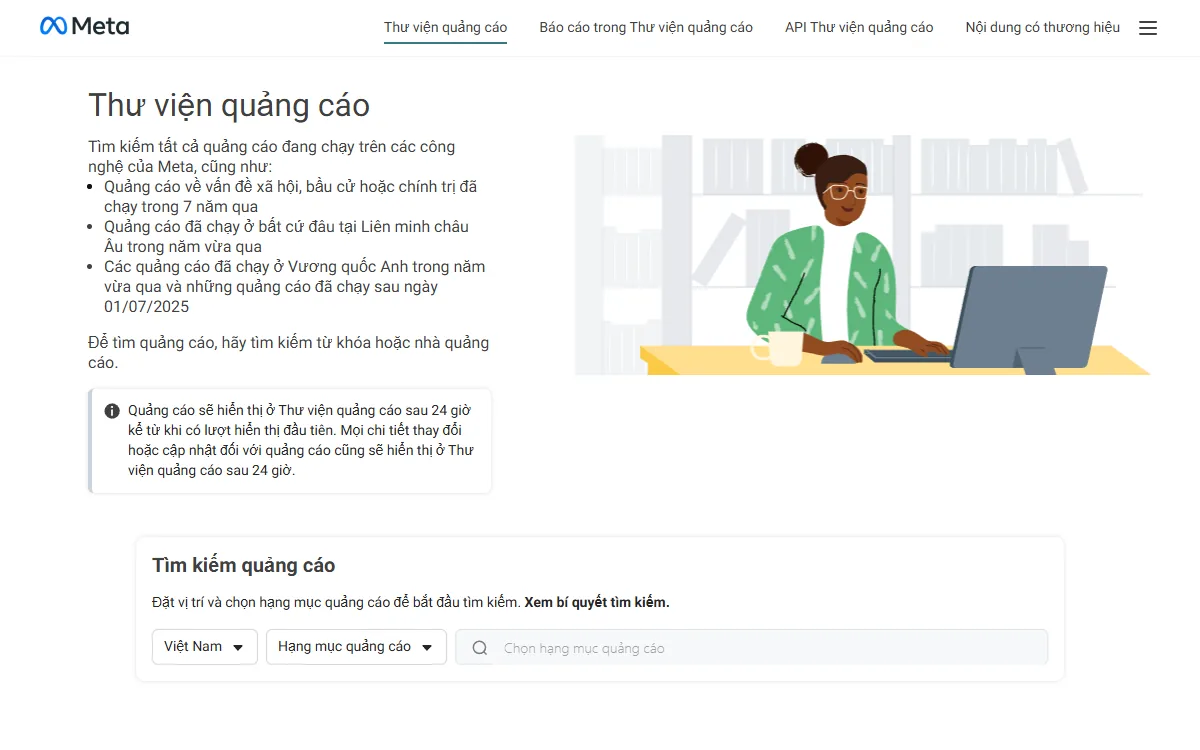
Meta Ad Library is Meta's free, public source for viewing ads on Facebook and Instagram. Choose a country (for example, United States), type in a product keyword, and the ads appear. Each ad shows the date it started running. Vietnamese-language labels may differ depending on the interface.
From what I've seen, for commercial ads targeting the US, the Library mainly shows ads that are currently running; ads that have been turned off usually no longer appear. The display can vary by region and may change, so check directly in the Library yourself.
A quick way to read it that I often use:
- A Facebook Page with many ads for the same product, with many video variations: the shop is still willing to spend money on that product. This is a strong signal.
- Ads that have been running for several weeks and are still on: a signal worth watching, but it doesn't necessarily mean the shop is profitable.
- An ad disappearing from the Library doesn't necessarily mean the shop has dropped the product. They may have just turned off that ad and switched to a new video.
I cover filtering in more detail in the article finding products in the Ad Library and the article how long Facebook ads run.
2. The "start date" is not the video's real age
Beginners often fall into this trap: seeing an ad that started running yesterday and assuming the video is new too. From what I've seen, many shops rerun a video that has been running for months, just by creating a new ad. The ad date is new, but the video is old and many shops may have already run it. You can read more in the report Video Reuse Index (includes methodology and JSON data).
The manual way to check is to find which Pages the video has appeared on and since when. It takes time, but it keeps you from jumping into a saturated product. The guides on when a Facebook ad video was first posted and the article and on how many shops are running the same video give step-by-step instructions.
3. Study competitors' stores
To see what a dropship store that's performing well looks like, the most practical way is to check directly the stores of shops you come across in the Ad Library. When you look, pay attention to these points:
- Do they sell one product (one product store) or a whole niche?
- How are their prices, bundles, shipping and refund policies?
- How many ads is that Page running, and for which products?
From what I've seen, online "top dropshipping stores" lists are usually full of old stores or established brands that offer little value to beginners. Stores running many ads this very week are what show you where the market is heading. The article see the Facebook ads of a Shopify store explains how to view the Facebook ads of a Shopify store.
If you want to see how another store presents its products, read the article copying products from another Shopify store. Remember to rewrite the descriptions and use your own images, don't copy them as-is. At the testing stage, a free Shopify or Wix theme is enough. What's worth investing in is choosing products and making video ads.
4. Check search demand
Facebook ads show you what sellers are doing. Google search volume tells you whether buyers are looking for that product. Google Shopping is also a dropshipping channel, suited to products people actively search for, like home repair items or replacement parts. In my experience, products that make people "want it as soon as they see it" suit Facebook better.
Tools to help: use free ones first, pay later
You can easily start with just the Meta Ad Library and a spreadsheet. When the number of products you need to scan grows, an ad spy tool saves time. Below is a short introduction to my tool, including its limitations.
SpyWinAds (spywinads.com) is a Facebook video ad spy tool for online sellers (dropshipping, POD, Shopify stores) selling to the US. The data covers ads shown in the US, only Meta ads (Facebook, Instagram), with no TikTok or Google ads. Two key differences:
- Real age of the video: the earliest of the date the video file was first uploaded to Facebook (margin of error 1–2 days) and the first ad running that video, including ads that have been turned off. Without the file date, only the ad date remains, which is the minimum.
- Who is running the same video: groups the Pages and shops running the same video using visual fingerprinting, including reposts, re-compressed versions, and versions with changed text or music, and shows who ran it first within the scanned library.
Videos are sorted into Win / Scale / Old categories by server-side rules (see Win / Scale / Old). These are ad signals, not sales. SpyWinAds also only sees shops within its scanned library, not every shop on Facebook. Read more about us and the tool on the About page.
If you want to try it without creating an account, SpyWinAds has 4 free tools: look up video ads, look up Page ads, inspect Shopify stores, clone Shopify products to CSV. Ad lookup is 10 uses/day (30 uses with email), cloning is 3 uses/day (10 uses with email). You can try the free tools here.
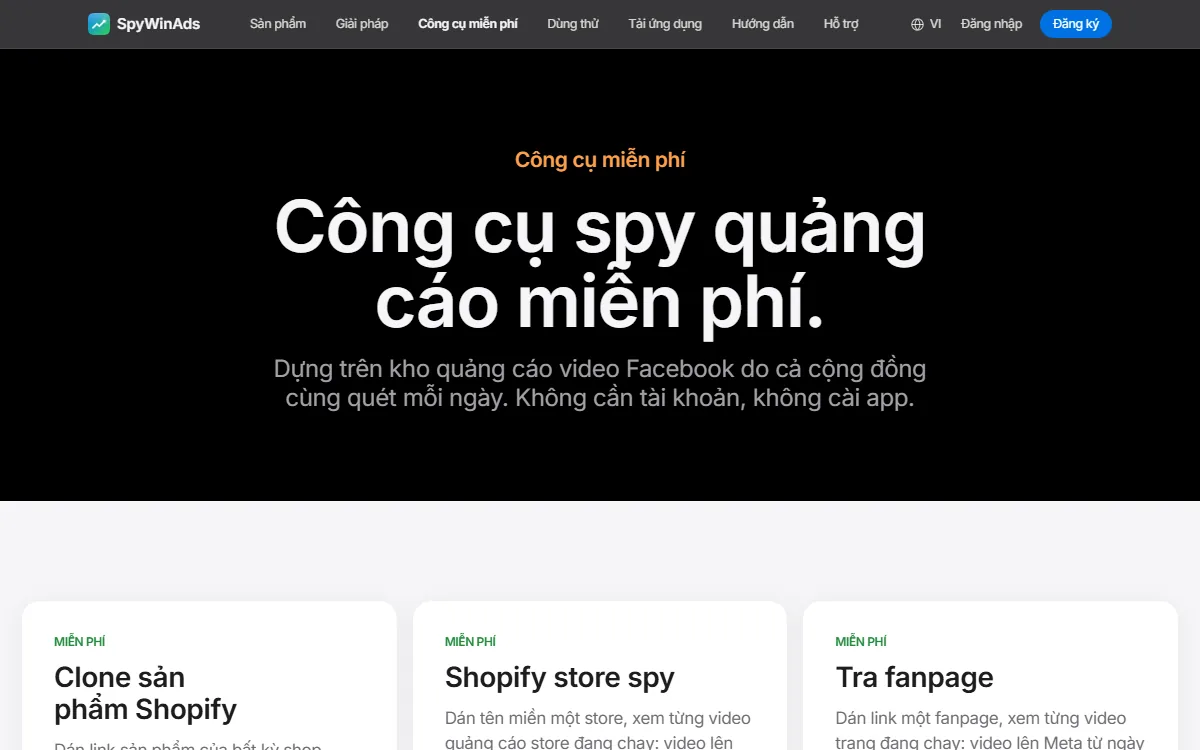
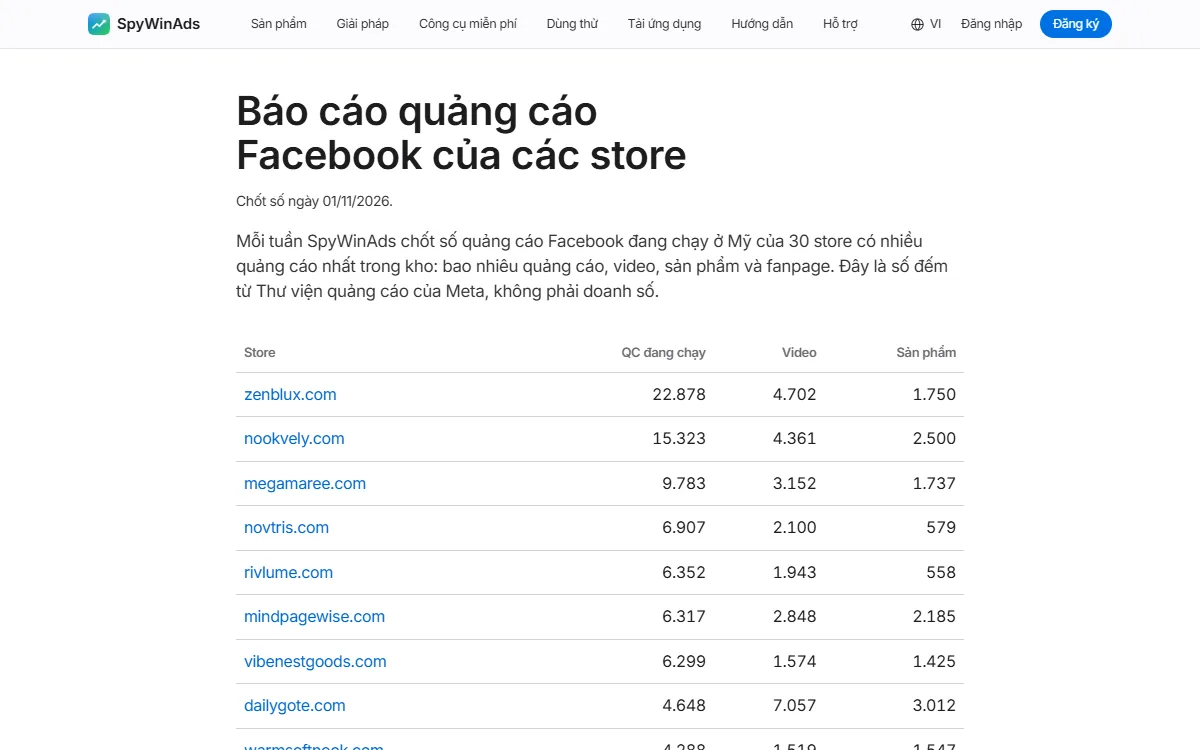
SpyWinAds also has store report lists the 30–50 stores running the most ads, finalized weekly, showing only counts and dates.
If you need a larger library or TikTok ads too, other tools are stronger in that area; the comparison is at comparison page.
How do you read hot product lists with a clear head?
Online "hot product" lists have two problems. First, once a product is on a public list, many people are usually already running ads for it. Second, nobody knows other shops' real revenue. What you can actually observe is the ads: how many there are, when they started running, and how many shops use the same video.
Instead of hunting for a "winning product," answer three questions:
- Is any shop steadily spending money on this product?
- Is the video they use new, or has it been passed around many shops for a long time?
- Do you have a different angle: a new video, a bundle, pricing, or a separate customer group?
From my experience, question 3 matters more than the first two. Without a different angle, you're just bidding up ads against whoever got there first.
Where do you start with dropshipping?
7-step checklist
- Choose a market (e.g., the US) and a main ad channel (e.g., Facebook).
- Spend 1–2 weeks browsing the Meta Ad Library and note 20–30 products that many shops are running.
- For each product, check the video's age and how many shops are running the same video.
- Find suppliers, and ask clearly about shipping time to the US and their return policy.
- Calculate your break-even point: the maximum ad spend per order.
- Build a simple store and make 2–3 ad videos with distinct angles.
- Set a test budget and a stop-loss point before you hit run.
If you want to scan ads with a desktop app, SpyWinAds has apps for Windows 10+ and macOS. The app doesn't need Google Chrome or a Facebook login. You get a 7-day free trial, no card required. After 7 days the app stops scanning and doesn't charge you automatically (as of 02/11/2026).
FAQ
What is dropshipping, and is it like order-based selling?
Pretty much the same, except for who ships. With order-based selling, the goods usually come to you first and then you deliver them to customers. With dropshipping, the supplier ships directly to the customer and you never touch the goods.
What is dropshipping, and does it need capital?
You don't need money to buy inventory, but you do need money for ads and some platform fees. Ad spend to test products is usually the largest cost. Set aside a test budget you're prepared to lose.
Can you do dropshipping from Vietnam and sell to the US?
Yes, many Vietnamese sellers do it this way: a Shopify store, Facebook ads targeting the US, and suppliers shipping directly. You need a payment gateway that accepts payments from international customers. You also need a supplier who can deliver to the US within an acceptable time.
Are there free tools for finding dropshipping products?
Yes. Meta Ad Library is Meta's free, public source for viewing ads. In addition, SpyWinAds has 4 free tools no account needed: look up video ads, look up Page ads, inspect Shopify stores, and clone Shopify products to CSV (ad data shown for the US).
Does an ad running for a long time mean the product is profitable?
Not necessarily. An ad that runs for a long time shows the shop is still willing to pay for it, which is a strong signal. But from the outside, nobody knows whether that shop is profitable. Treat it as a reason to look closer, not as proof.
Original data from the SpyWinAds library: how Facebook video ads get reused ›